
Feel better before things go wrong.
Understand and track your digestive problems easily, day after day.
Bowel habits, diet, mood, sleep, stress, activity… share with JOJO everything that happens in your daily life so that it helps you understand your body over time, identify what influences you and, tomorrow, better anticipate difficult periods.
I want to try JOJO


Digestive disorders are not simply digestive.
Your body is talking to you. What if you finally listened? JOJO learns to connect the signals, day after day.
JOJO is your copilot specialised in the gut–brain axis.
Disorders of gut–brain interaction (DGBI)
Irritable bowel syndrome, constipation, diarrhoea, dyspepsia, bloating… These so-called “functional” disorders are thought to affect up to 42% of adults.
Long regarded as symptoms with no identified organic cause, they in fact involve multiple mechanisms: diet, microbiota, intestinal inflammation and disturbances in the communication between the gut and the brain.
This is why we now speak of disorders of gut–brain interaction (DGBI) rather than functional bowel disorders.

A medical appointment sees a photo, whereas your symptoms play out like a film.
A meal. A bad night. A stressful week.
A change of routine. A pain that comes back three days later.
Taken separately, each of these events says little. But over the days and weeks, they form a story. Your story.
Today, this story is often fragmented between what you remember, what you note down somewhere, what you say during a consultation and everything you end up forgetting.
The result: you know something is wrong, without always managing to understand what, why, or what really helps you.
The symptoms are real. So is the lack of continuity.
Bloating, abdominal pain, disrupted bowel habits, fatigue, discomfort after meals, digestive anxiety…
These symptoms can change from one day to the next and be influenced by many factors.
Yet the person living with them is often left alone with one very simple question:
“What is happening in my body?”
What if your body finally had a memory?
JOJO builds your body’s memory.
JOJO turns your daily life into understandable, structured data, then gradually learns to recognise your own patterns.
Not those of an average user. Yours. For real, over time, continuously.
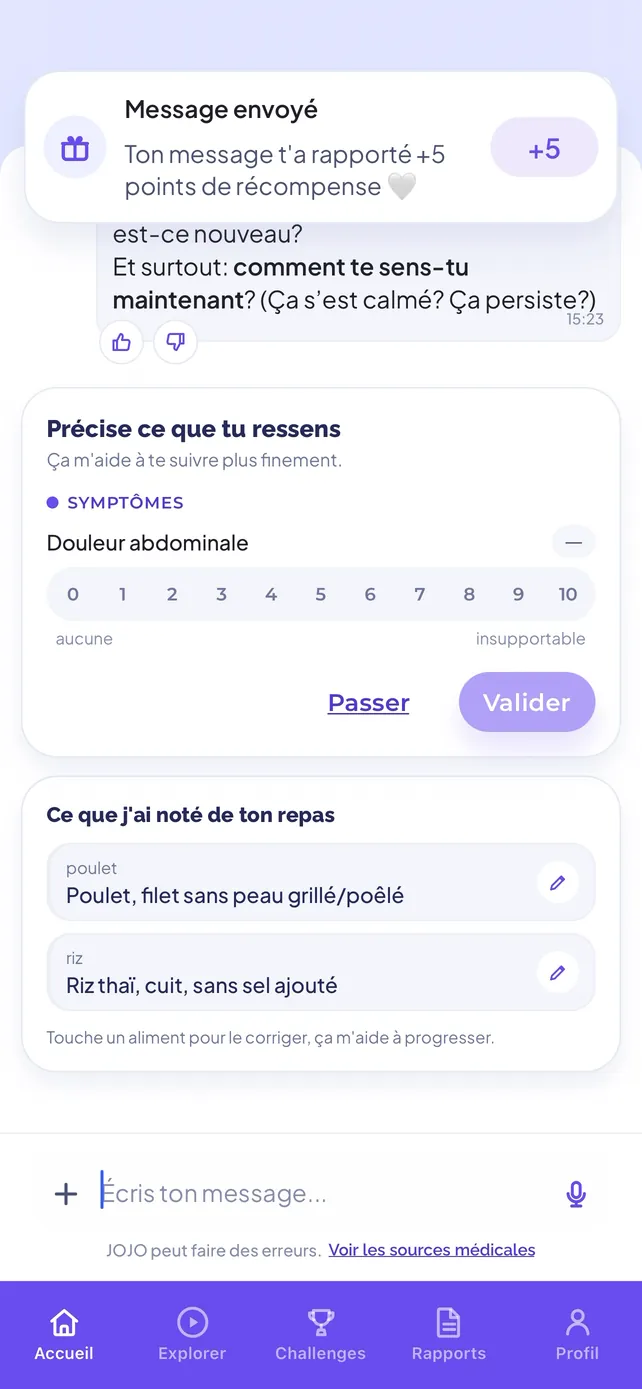
Tell
No need to fill in a symptom spreadsheet. You simply tell JOJO how you are, what you have eaten and what happened in your day.
JOJO gradually turns this information into structured tracking data.
Connect
JOJO puts your symptoms into perspective with different factors in your daily life: diet, sleep, stress, mood, activity and other relevant data.
A single data point says little.
Several weeks tell a story.
Several months tell a whole film.
Understand
JOJO looks for trends over time to help you identify what seems to improve or worsen your digestive comfort.
You can finally take a step back from what you feel.
Anticipate
Our ambition goes further than understanding what has already happened.
By studying the signals that precede periods of symptoms, we are developing models capable of identifying at-risk situations and, in time, helping everyone act before a flare-up sets in.
Understand the past. Act in the present. Anticipate tomorrow.
Understanding the gut–brain axis requires looking at more than a symptom.
Disorders of gut–brain interaction are multifactorial by nature.
Diet, the nervous system, sleep, stress, activity, environment and digestive symptoms interact over time.
It is precisely this longitudinal dimension that JOJO seeks to capture.
Discover our scientific approachBetween two consultations, life goes on. So does the data.
A consultation often relies on a few minutes of discussion and on the patient’s memories of the previous weeks.
JOJO is exploring another approach: structuring everyday information so as to gradually obtain a clearer longitudinal picture of how symptoms evolve.
The aim is not to replace the health professional.
It is to create more continuity between real life and the care pathway.
Are you a health professional? Discover JOJO ProTHEY SUPPORT US
Ecosystem & support








Research & health

Your gut talks to you every day.
What if you finally started listening to it differently?